2,000,000 microwatts of FM Entertainment
On August 26, 2014, WORC installed the 95.1 MHz transmit antenna on a tower within a
communications compound on Mt. Scott. On October 21, 2014, Ken Seymour successfully
negotiated the use of the historic KISN call sign with the licensee of the current full power
KISN radio station near Bozeman, Montana. A press release issued on November 28,
2014, announced the milestone, with Ron Polluconi declaring that “after 38 years, the KISN call
sign and radio signal would finally return to Portland via the FM airwaves.” On May
1, 2015, at 9:51 a.m., KISN-LP began broadcasting 24 hours a day -exactly 56 years to the day
after the original KISN AM first signed on in 1959.
Since KISN is authorized by the FCC to operate as a Low Power FM radio station, serving the
Porland East side, reception is based strictly on your geographic location (in relation to the
transmitter located on Mt Scott), terrain, and how well your receiver performs. To a
lesser extent, time of day, sunspot cycles, and other Morphology features (vegetation,
buildings, water boundaries, etc.) will affect the signal level received at your receiver.
The other variable is co-and-adjacent channel interference that the receiver picks
up from other full power FM stations.
Figure 1 below, shows the FCC signal level contours based on the location of
the transmitter. The signal levels in the legend are estimates based on computer
simulations. Obviously, the closer you are located to the transmitter site the
better you will receive the signal. Although, the map is relatively easy to view
and interpolate, it doesn't really show how terrain and other features effect signal propagation.
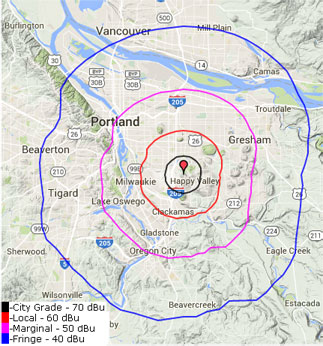
Figure 1, FCC Predicted Signal Contours
Figure 2 below, shows the computer simulated propagation model using terrain
data as the foundation. Thus, this type of map will give a better indication of how
terrain affects the signal received by your radio. Theoretically, this is the signal
that you would receive on your radio in a "totally interference free" environment.
An interference free environment will never happen in the real world as there are co-and
adjacent channel interference scenarios that all stations are subject to.
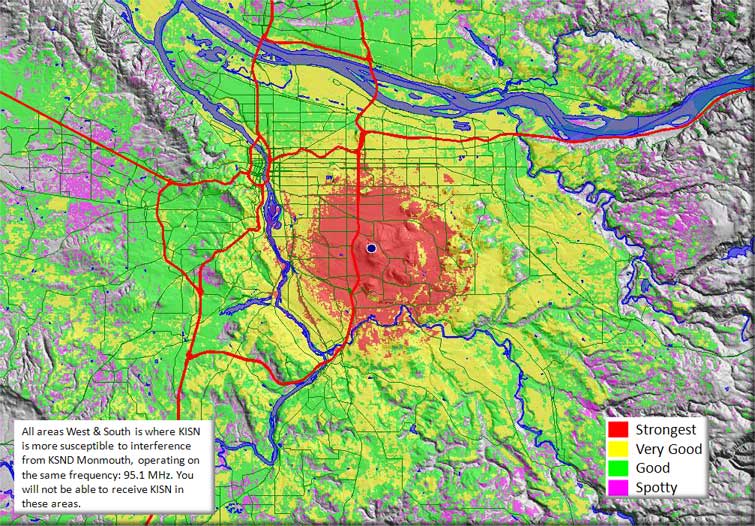
Figure 2, Computer Modeled Coverage
The map shows how the terrain affects KISN's signal. Other factors are also taken
into account with this computer model. Such as Morphology as mentioned above.
Notice that the Yellow "Very Good" (50 dBu) signal color goes quite a distance beyond that of
where the 50 dBu signal in Figure 1 shows. This is partially due to terrain that
typically slopes and faces the Mt. Scott KISN transmitting antenna. In addition,
due to the height of Mt Scott, there are less Morphology losses which correspondingly reduce
the path losses between the transmitter and receiver. Thus, the signal is received
better in those situations. You can also see how the terrain shields some of the
signal in areas where the color changes abruptly within a solid color area. One
disadvantage of the transmitter height, is that more multipath signal reflections are often
present.
Remember, these illustrations are just computer models and the coverage maps are not 100%
perfect. But it gives you a basic idea of what coverage you would expect to receive
on your car radio. Notice, that we said "car" radio. Only in the Red (and perhaps
some Yellow) coverage areas are you likely to receive KISN in-buildings on a "home" receiver.
In the Green areas, KISN does not have enough signal strength to penetrate into
your house and be captured by your receiver without the use of an external antenna.
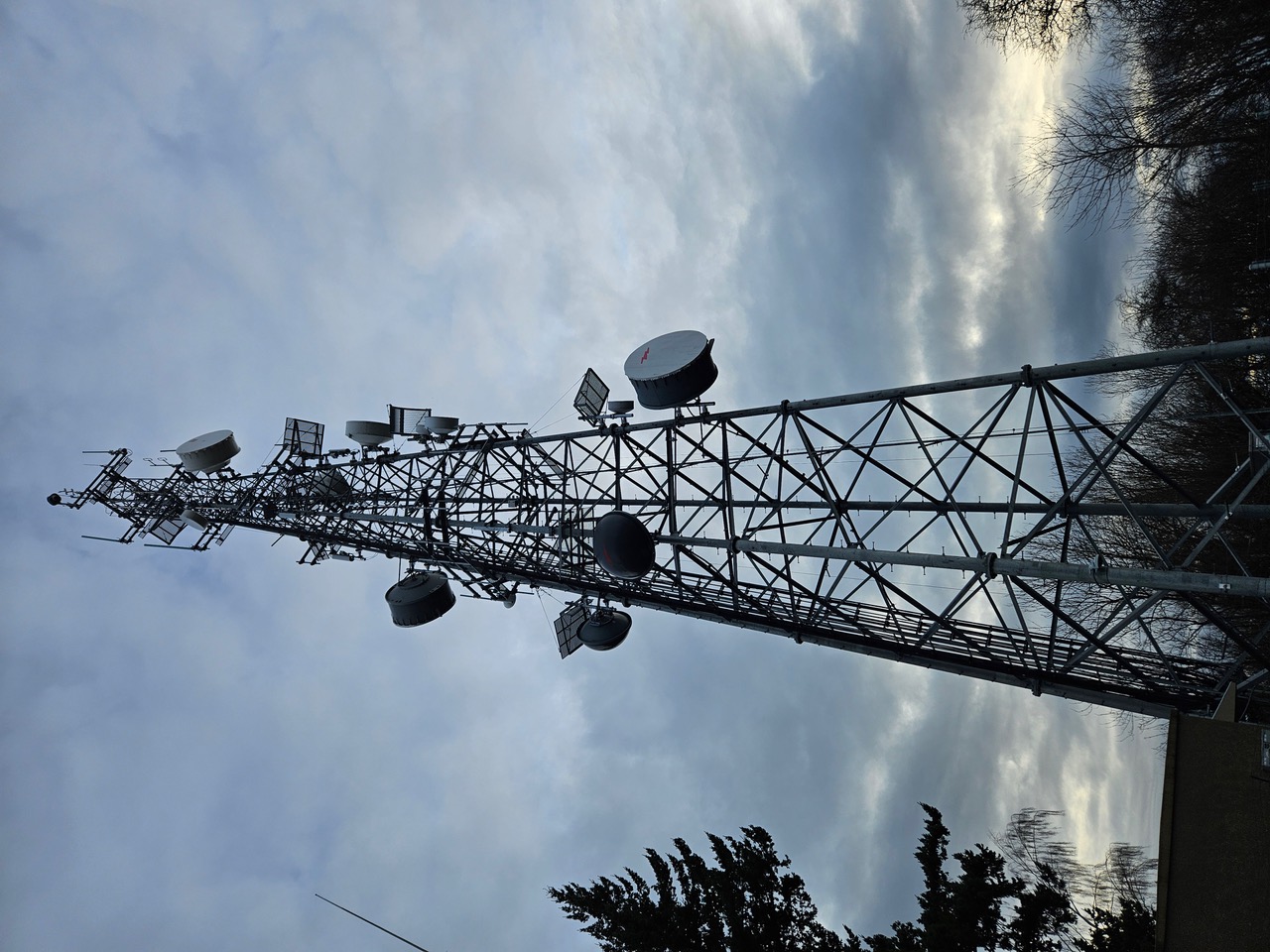
Figure 3, WORC Mt Scott Repeater Site & KISN-LP
For those listeners who are more ambitious and would like to install a Yagi antenna on your
rooftop to pick KISN up better in fringe areas we recommend selecting an antenna similar to
this one available from
Amazon.
This is a directional antenna with relatively high gain. It should work well with
most home tuners and stereo receivers. You will also need to purchase an inexpensive
impedance matching Balun which is very important to have in order to match the antenna
impedance to that of the coax that you feed to your receiver. Yagi antennas have
300-ohm output impedance and they must be matched to the coax line to insure minimal signal
loss. Typical 75-ohm coax to use is RG 59/U and can be found on the web or locally
at hardware stores. Refer to Figure 4 for details on antenna installation.
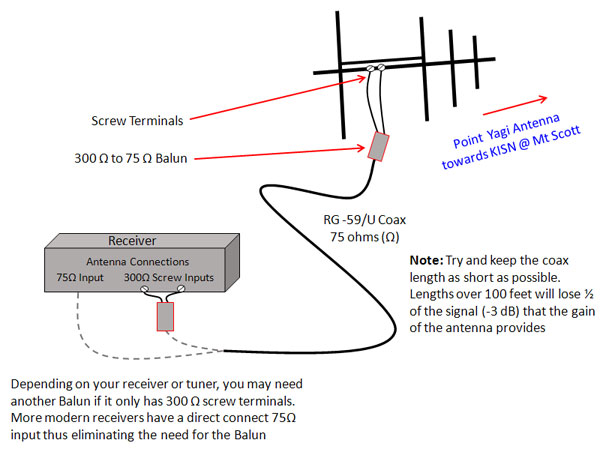
Figure 4, Installation of Yagi Antenna
Car Radio Preset Buttons
If your car has an "Auto Scan" or "Seek" button on the radio where it searches for stations,
odds are that the radio will not find KISN unless you happen to be in an area where the signal
is strong. In this case, you need to put your FM radio into "manual" tune mode.
Then, tune to 95.1 by jogging through the frequencies. Once 95.1 is found and
tuned-in, follow up by setting your radios "preset" button. It isn't really clear
on most car radios how to get it into "manual" tune mode. So, you may have to dig
out your vehicle user's manual and read up on how to accomplish this.
To visit the KISN Radio website and listen to the stream
click here
Since KISN-LP’s coverage area is essentially east Portland, another independently owned ham
radio club operates a sister station, not affiliated with the WORC, located in Washington
County. This is KQRZ-LP 100.7 (Tigard) and simulcasts on 96.7 FM (Aloha/Beaverton).
To visit the KQRZ Oldies Radio website and listen to the stream
click here.